
Table of Contents
- Spotify Wrapped 2025: Pioneer of Data Storytelling
- Apple Music Replay 2025: Ecosystem Power and Premium Aesthetic
- YouTube 2025 Recap: The Annual Digital Report of the Video World
- YouTube Music Recap 2025: Ecosystem Integration and Personal Music Profile
- The Annual Ritual of Digital Culture: Wrapped & Recap 2025
- Conclusion: The New Era of Data, Creativity, and Marketing with 2025 Wrapped Reports
Share
As of 2025, digital music platforms have evolved beyond mere content consumption applications to become one of the strongest determinants of user identity, cultural trends, and social media behavior. The annual Wrapped, Replay, and Recap reports published by Spotify, Apple Music, YouTube, and YouTube Music are now recognized as a major digital ritual at the intersection of technology, data, and popular culture. These reports allow millions of users to reinterpret their year through music while simultaneously creating a global marketing season marked by record-breaking engagement for the platforms.
What makes the Wrapped/Replay/Recap culture so special is not just the listing of songs users listened to throughout the year, but the way the underlying behavioral insights, AI models, consumption rhythm analyses, and emotion-based listening habits are presented to the user as a personal narrative. Platforms no longer simply show “what was listened to”; they analyze when, with what emotion, within which habit cycles, and triggered by what contextual factors the music was consumed. By 2025, advanced machine learning algorithms, audio fingerprinting technologies, personalization engines, and time-series behavior models form the foundation of these reports.
Spotify has leveraged its cultural power to transform Wrapped into much more than a brand campaign. Wrapped has now become a way for users to express their digital identity on social media. Apple Music, on the other hand, consolidates its premium ecosystem and refined user base by offering a more aesthetic, analytical, and personalized year-end experience through Replay. YouTube integrates not only music but also video viewing behavior, Shorts consumption, interactions with content creators, and multifaceted in-platform behavior patterns into Recap, elevating the scope to a new level. YouTube Music transforms Recap into a more personal story flow for younger audiences with a dynamic experience, strong recommendation algorithms, and visually-focused presentation.
In the midst of this digital competition, the 2025 Wrapped season has become a “data arena” where technical innovations and marketing strategies converge. Each platform showcased its technological capabilities, level of personalization, and ability to manipulate user psychology to maximize both user engagement and social media dominance. Now, let's examine the 2025 Wrapped performances of these four major players, analyzing both technical and marketing aspects individually.
Spotify Wrapped 2025: Pioneer of Data Storytelling
As the creator of the Wrapped concept, Spotify continued to maintain its leading position in shaping the rhythm of digital culture in 2025. By combining the massive flow of data generated by billions of listeners throughout the year with creative storytelling, Spotify has transformed music consumption from a mere habit into a global cultural phenomenon. Released on December 3, Wrapped 2025 was announced with the tagline “More layered and captivating than ever,” once again raising the bar in this year’s competition. Spotify, now the first brand that comes to mind when year-end is mentioned in the digital world, positions Wrapped not as a product but as an experience that visualizes the emotional memory users have created throughout the year.
Spotify no longer simply provides a service summarizing users’ listening habits; it creates a narrative experience that transforms data into sociological insights and redefines personal digital identity. The social media impact of Wrapped extends beyond individual shares, creating a massive communication space for brands, influencers, artists, and communities. In doing so, Spotify not only strengthens its brand power but also deepens, personalizes, and amplifies the connection users have with music.
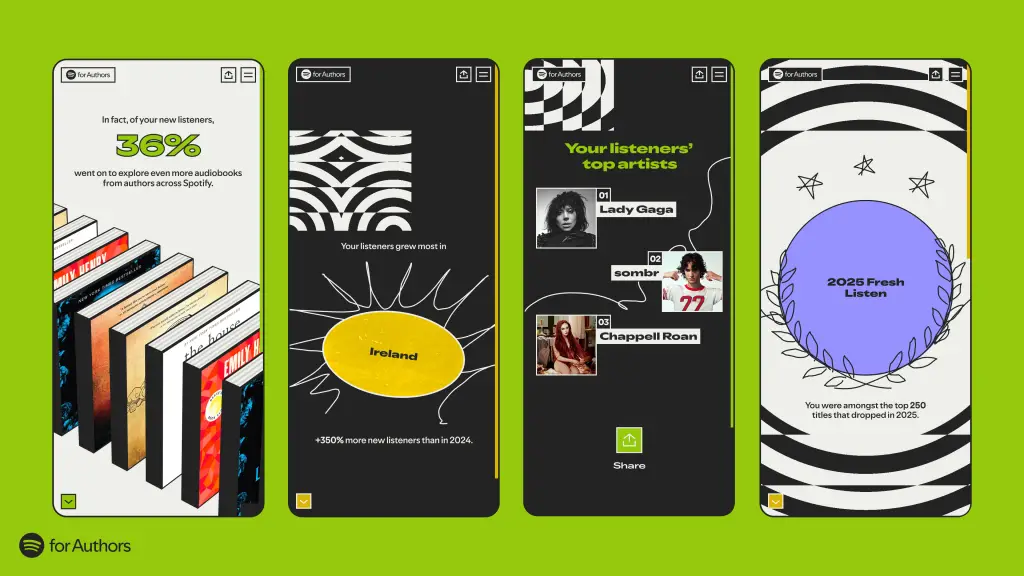
This year’s Wrapped goes far beyond the simple ranking logic of previous years, offering an experience that centers on the psychological dimensions of listening habits, emotional contexts, and community feeling. In the 2025 edition, users’ relationships with music are analyzed through moods, rituals, specific time cycles, and personal stories throughout the year, resulting in a more layered digital portrait. The new interface, designed with a “visual mixtape” aesthetic, transforms Wrapped from a report into a digital journey thanks to both powerful storytelling and a highly engagement-focused UX approach. Presenting listening data through colors, animated typography, motion, and rhythm-based transitions creates a cinematic experience that allows users to relive their year. In this way, Spotify strengthens its position not just as a music platform but as a cultural brand that shapes users’ annual identity narratives.
The “Listening Age” and “Wrapped Clubs” Revolution
Spotify’s technical innovations in 2025 once again demonstrated the company’s strength in combining data processing capabilities with storytelling. The platform analyzed petabytes of streaming data processed throughout the year in real time using Hadoop- and Kafka-based architectures, creating highly personalized summaries for each user. The most notable technical innovation this year was the introduction of the “Listening Age” assigned to users. Powered by the advanced Audio Analysis API, this feature examined the release years, periodical popularity, and acoustic DNA of the songs listened to, determining the age range of a user’s musical taste. This analysis provided surprising insights by revealing how closely (or how divergently) listening habits aligned with biological age. Additionally, the AI-powered “Listening Archive” transformed the year’s most meaningful days, most nostalgic streams, or periods of peak discovery into personalized textual reports. For the first time, the “Spotify stats experience” became a narrative summary composed not just of numbers but of personal stories.
Another technical breakthrough was the “Wrapped Clubs” system. This year, Spotify added a new community-based layer to Wrapped 2025 by categorizing users into six different clubs based on listening behavior. The system analyzed users’ listening histories throughout the year with advanced clustering algorithms, placing them into social tribes such as “Club Serotonin” (energetic), “Grit Collective” (rock/rebellious), and “Cloud State Society” (calm/lofi-focused). This approach identified social identity similarities across anonymous data sets and allowed users to see their musical personality within a community framework. Accessing Spotify Wrapped was also simplified; users could enter the experience with a single tap through club badges on the app’s homepage.
How Musical Personality is Determined? (K-Means Clustering)
Spotify assigning you to groups like “Club Serotonin” or “Grit Collective” is essentially a classic Unsupervised Learning problem. Spotify separates each song into specific vectors via the Spotify Audio Features API (Danceability, Energy, Acousticness, Valence - Happiness score).
The system feeds billions of users’ listening data into a K-Means Clustering algorithm in a multidimensional space. The average vector of the songs you listened to throughout the year determines which cluster centroid you are closest to, and that is the “Club” you are assigned to.
Here is a simplified Python simulation of this logic:
import numpy as np
from sklearn.cluster import KMeans

# Average audio features of songs listened by the user throughout the year
# [Energy, Valence (Happiness), Acousticness, Danceability]
user_audio_features = np.array([
    [0.85, 0.90, 0.10, 0.88], # User A (Highly Energetic)
    [0.20, 0.30, 0.85, 0.40], # User B (Melancholic/Lofi)
    [0.60, 0.40, 0.10, 0.50]  # User C (Balanced Rock)
])

# Predefined "Wrapped Clubs" clusters by Spotify
kmeans = KMeans(n_clusters=3, random_state=42)

# Fit the model and classify users
clubs = kmeans.fit_predict(user_audio_features)

club_names = {0: "Club Serotonin 🌞", 1: "Cloud State Society ☁️", 2: "Grit Collective 🎸"}

for i, club_id in enumerate(clubs):
    print(f"User {i+1} Assigned Club: {club_names[club_id]}")
“Wrapped Party” and the Power of Community
The biggest marketing innovation of Spotify Wrapped 2025 was the “Wrapped Party” feature, which transformed data from an individual experience into a social interaction-focused game. Available only on mobile, this experience allowed users to form friend groups and compare who discovered the most new artists, whose listening habits were most aligned, or who explored the widest musical range throughout the year. This social competition mechanism turned Wrapped from a personal report into a multiplayer game, dramatically increasing the platform’s virality. Share rates reached an all-time high compared to previous years; the annual Wrapped week created a true festival effect on social media.
Another highly talked-about marketing move in 2025 was the “Fan Leaderboard” system. Designed to strengthen artist-fan engagement, this feature showed users their rankings among the global listener base of their favorite artists. For example, badges like “You are in the top 0.5% of Bad Bunny listeners” allowed users to position themselves within the community. This year, Bad Bunny being the most-streamed artist globally, followed closely by Taylor Swift, reaffirmed the digital listening power of the Latin music industry. Although technical glitches during Wrapped week led some users to complain that “Spotify Wrapped is not showing,” most issues were due to not using the latest app version and were quickly resolved. Despite these minor setbacks, Spotify Wrapped 2025 achieved one of the highest performances in the platform’s history in terms of social media impact, user engagement, and brand power.
Apple Music Replay 2025: Ecosystem Power and Premium Aesthetic
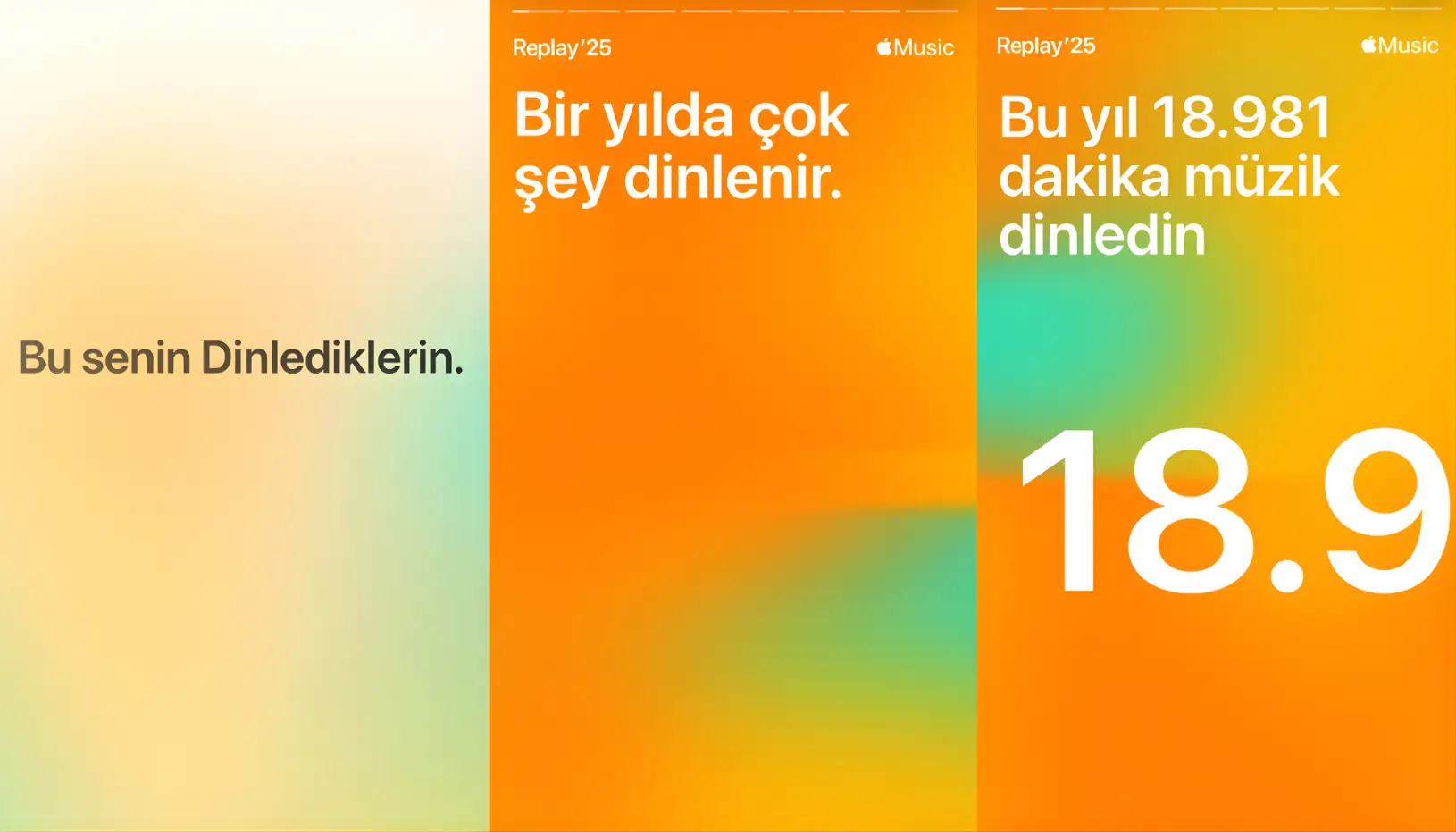
Released on December 2, Apple Music Replay 2025 successfully elevated Apple’s long-standing “simple yet powerful” approach to data presentation to a new level this year. As detailed by Forbes, Apple Music set itself apart from competitors by offering users not just a one-time year-end report, but a dynamic, continuously updated data experience accessible throughout the year. The 2025 version of Apple Music Replay stood out as a refined year-end report reflecting Apple’s brand identity, with its premium design language, high-accuracy algorithms, and streamlined content flow.
Apple chose to avoid viral chaos in data presentation, focusing instead on organizing users’ musical habits into more meaningful, structured, and analyzable categories. This approach transformed Apple Music Replay from a simple year-end summary into an analytical platform that tracks users’ music tastes over the year, measures their progress, and supports their personal musical journey with concrete data. As a result, Apple Music Replay became a strong and reliable reference point for both loyal Apple users and data-driven music consumers.
Big Data and Stream Processing
Apple’s ability to keep data continuously updated throughout the year (making Replay dynamic) indicates that the data is managed using Stream Processing rather than traditional Batch Processing.
Every second millions of users press the “Play” button, these events are recorded into massive data queues (event logs) similar to Apache Kafka. Apple’s backend systems (likely based on Apache Flink or Spark Streaming derivatives) process this stream in real time, updating user counters instantly. Measuring “Loyalty” requires more than a simple counter; a Threshold algorithm is applied.
The logical query required for a song to enter the “Loyalty” list looks something like this:
class StreamProcessor:
    def process_event(self, user_id, song_id, listen_duration, song_length):
        # Threshold Check: Was at least 30% of the song listened?
        if listen_duration > (song_length * 0.3):
            # Increment the valid play count
            user_db.increment_play_count(user_id, song_id)
            # Milestone Check: Has the 100th play been reached?
            current_count = user_db.get_play_count(user_id, song_id)
            if current_count == 100:
                self.trigger_milestone_badge(user_id, song_id, "Loyal Listener")
    def trigger_milestone_badge(self, user_id, song_id, badge_name):
        print(f"CONGRATULATIONS! {user_id} earned the '{badge_name}' badge for {song_id}!")
Discovery, Loyalty, and Comebacks: Apple’s Three-Layer Data Architecture
Apple Music Replay 2025 organized its algorithms into three key categories this year to make data presentation more behavioral and personalized, helping users better understand their musical journey. This system transforms Apple’s long-standing machine learning and listening behavior analytics into a more complex, intuitive, and meaningful structure.
Discovery
One of the most exciting sections of Replay, Discovery reveals the new artists and songs you encountered throughout the year. Apple’s algorithm does not just consider superficial listens; it analyzes content you truly connected with, added to your library, or repeatedly listened to. As a result, the Discovery section provides a clear window into how your musical horizon expanded over the year.
Loyalty
This category forms the backbone of Apple Music’s data processing approach, focusing on artists you have consistently listened to over the years rather than following fleeting trends. Apple analyzes listening frequency, repeat rates, and long-term engagement to identify the most stable elements of your musical identity. This metric serves as a strong indicator of long-term platform loyalty, playing a critical role in understanding user behavior and enabling personalization.
Comebacks
The nostalgia-focused Comebacks section identifies artists you had taken a break from but reintroduced into your rotation in 2025. Apple’s behavioral analytics examines cycles and seasonal returns in your music taste, providing users with both emotional and analytical insights. This section became one of Replay 2025’s most notable innovations, highlighting the relationship between returning artists and user psychology.
All of this data is presented natively within the Apple Music app’s “Home” tab. Users can track listening levels throughout the year via Monthly Insights, while reaching specific listening milestones awards Milestones badges, gamifying the experience. At the end of the year, the combination of these three categories generates a comprehensive annual report, giving users a detailed summary of their musical behavior.
This approach clearly demonstrates that Apple views data not merely as a year-end marketing campaign but as an ongoing service.
Marketing Impact: Premium Identity, Minimal Design, and Focused Sharing Strategy
Apple Music’s marketing strategy in 2025 remained centered on a “premium, simple, and music-focused” identity. Unlike Spotify Wrapped’s colorful, viral, and community-driven approach, Apple opted for a more selective, refined, and controlled presentation. This strategy positioned Apple Music Replay not as a social media spectacle but as an aesthetic reflection of a personal music archive.
Replay 2025 share cards were specially optimized for platforms like Instagram, TikTok, and X. Minimal typography, high-resolution backgrounds, brand-specific contrast colors, and clean layouts reinforce Apple’s premium brand perception. Users can easily share their listening time, most-played albums, and personal stats across the three new categories using these dedicated cards.
This approach provides Apple with two major advantages:
-
Strengthened music-focused brand perception:
It reinforces the message that the platform values quality over quantity for its users. -
More controlled and selective sharing behavior:
Apple’s aesthetic standards make Replay shares appear more “premium” on social media.
In conclusion, Apple Music Replay 2025 stands out as a year-end experience designed not for virality but for value creation. Supported by data kept up-to-date throughout the year, this system enhances user loyalty while redefining the premium standard in the digital music ecosystem.
YouTube 2025 Recap: The Annual Digital Report of the Video World
As of 2025, YouTube is not only the largest video platform in the world but also a massive ecosystem shaping digital culture, setting internet trends, and acting as a central hub for global marketing strategies. Reaching over 2.7 billion active users per month, YouTube now represents much more than a video-watching platform: it influences content creators’ careers, transforms brand communication, and reveals users’ personal interests and digital identities.
In recent years, the wave of “digital report cards” created by Spotify Wrapped, Apple Music Replay, and Instagram Playback has gained popularity as users seek entertaining and shareable summaries of their consumption habits. This cultural shift prompted YouTube to reposition its annual summary format in 2025 with a broader vision. YouTube Recap 2025 is not just a list of watched videos; it combines video, information, music, entertainment, and lifestyle consumption to provide a comprehensive map of users’ digital viewing activity throughout the year.
This year’s Recap merges YouTube’s powerful algorithmic infrastructure with visual storytelling, detailing how users experienced a digital journey throughout the year. The platform analyzes not only which videos were watched but also how this content influenced learning, entertainment, inspiration, or routine behaviors. Consequently, YouTube Recap 2025 transforms into a digital profile experience that helps users understand their year-long digital identity, makes personal preferences visible, and encourages deeper engagement with the platform.
Through this holistic approach, YouTube, with the 2025 Recap, repositions itself not just as a video-watching platform but also as a space that stores personal digital memory. The Recap’s high shareability and entertaining presentation enhance user interaction, strengthen brand loyalty, and make YouTube’s influence on digital culture even more visible.
Viewer Type and Personal Interests
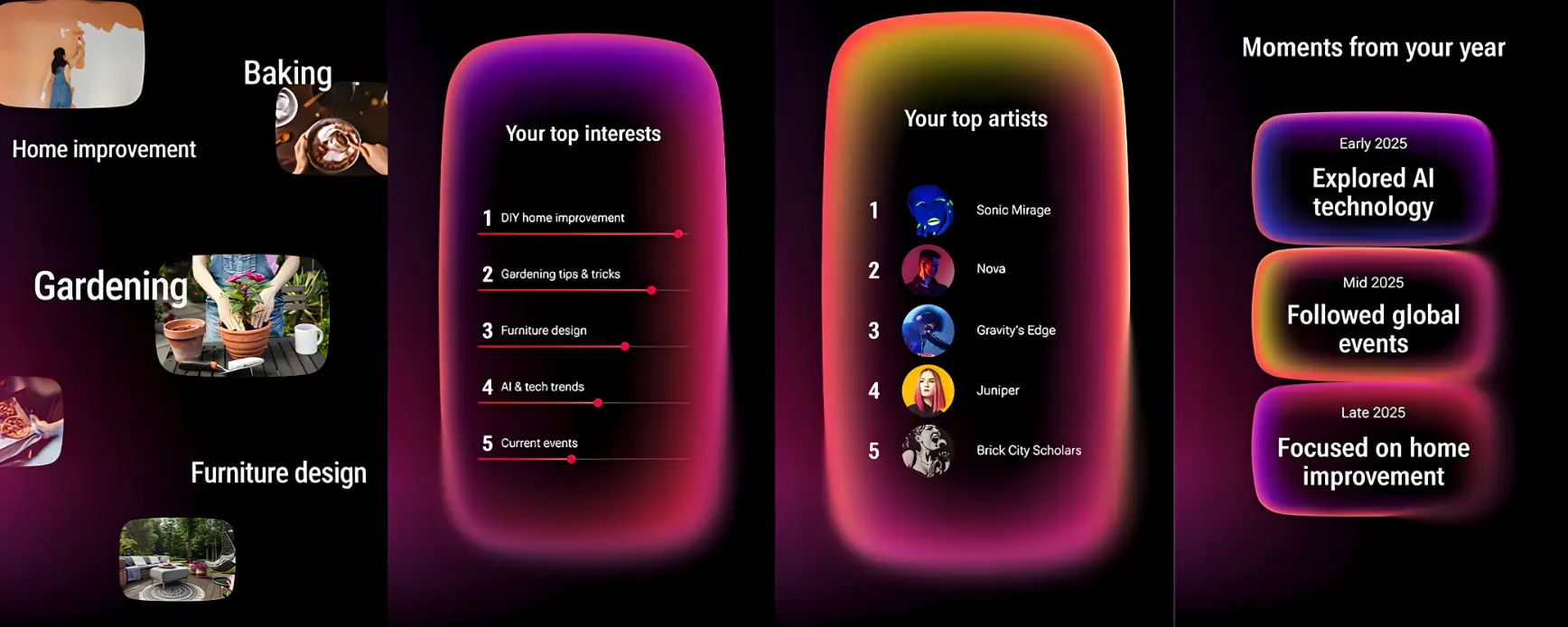
YouTube’s 2025 algorithm analyzes the videos users watch throughout the year, the channels they follow, their search habits, and the content they repeatedly return to, creating a comprehensive dataset. The most notable technical innovation this year was the platform’s “Viewer Type” classification assigned to each user.
If a user consistently seeks new information throughout the year, their profile is labeled “Discovery-Focused”; if they show strong interest in entertainment content, “Entertainment-Centric”; and if music and performance videos dominate, “Rhythm-Oriented”. This way, YouTube transforms data from mere statistics into a personal identity card.
Additionally, Recap 2025 visualizes rewatched videos, peak viewing hours, and yearly viewing trends with colorful graphics, making it easier for users to understand their digital habits. The system, which offers great convenience on mobile, is active for both paid Premium and free accounts. Users can access it directly via the “You” tab at the bottom of the mobile app or the corresponding Recap page on desktop.
Personalized Experience and Shareability Power
YouTube’s Recap strategy positions the platform in a completely new marketing dimension. Transforming users’ yearly viewing into a “personal digital summary” allows YouTube to give people the opportunity to share their media consumption as an identity statement.
The individually assigned “viewer types” make it easier for users to express themselves on social media, while the design of the shareable cards is entirely built around these insights. Recap shares, frequently seen on platforms like Instagram and TikTok, increase YouTube’s visibility while driving user returns and engagement.
Additionally, YouTube keeps Recap fully accessible for free, maximizing its mass marketing advantage. This democratizes the user experience and makes YouTube the only platform at a global scale offering a “public yearly summary” for everyone. As a result, YouTube Recap 2025 is not only a technical innovation but also a marketing move that strengthens YouTube’s personalized content strategy, keeps users engaged within the ecosystem, and creates a lasting impact on digital culture.
“Multimodal” Structure Combining Video and Audio
YouTube’s greatest advantage is its ability to combine visual data from videos (Computer Vision) with audio data. When determining a “Viewer Type”, not only metadata (tags) but also the actual video content is analyzed.
To determine if a user is “Discovery-Focused”, the algorithm examines the Cosine Similarity between videos in the vector space. If the videos a user watches are semantically distant from each other (e.g., watching a cooking tutorial followed by a quantum physics video), the angle between vectors is wide, and the system labels the user as a “Discoverer.”
from sklearn.metrics.pairwise import cosine_similarity
# Video embeddings (vector representations)
video_vectors = [
    [0.1, 0.2, 0.9], # Video A: Quantum Physics (Science-heavy)
    [0.9, 0.1, 0.1], # Video B: Cat Videos (Entertainment-heavy)
]

# Measure similarity between two watched videos
similarity = cosine_similarity([video_vectors[0]], [video_vectors[1]])
if similarity < 0.3:
    print("Viewer Type: DISCOVERER 🚀 (Dived into very different worlds)")
else:
    print("Viewer Type: FOCUSED 🎯 (Deepened in a specific niche)")
YouTube Music Recap 2025: Ecosystem Integration and Personal Music Profile
As of 2025, YouTube Music has become one of the fastest-growing platforms within the Google ecosystem, reaching millions of users globally and in Turkey, establishing itself as a strong and recognizable brand. Leveraging YouTube’s dominant position in video, YouTube Music has recently transformed into a preferred music platform, especially among younger audiences, carving out a unique position alongside industry giants like Spotify and Apple Music.
With the global “Recap” culture evolving into a digital ritual, YouTube Music has started delivering the highly anticipated personal music summaries in a more comprehensive and integrated manner each year. The 2025 Recap is no longer a simple feature that lists listening data; it has evolved into a deeper algorithm synchronized with YouTube’s overall viewing habits. This is where YouTube Music’s greatest strength emerges: when music consumption merges with video-watching behavior, users’ digital music identities can be visualized in a far more holistic way.
This year, Recap goes beyond a simple summary, combining discovery-focused listening patterns, frequently revisited artists, playlist preferences shaped by mood, and in-year music trends into a visually compelling presentation. YouTube Music Recap 2025 makes users’ personal connection with music more visible, transforming the platform from a mere streaming service into a brand experience that documents and enables shareable insights into users’ digital music journeys.
10-Hour Rule and Year-Round Data Profile
One of the most notable technical innovations of YouTube Music Recap 2025 is its ability to provide users with a single unified profile thanks to deep integration with the main YouTube platform. Users who listen for at least 10 hours throughout the year on YouTube Music are automatically included in the Recap experience. This “10-Hour Rule” forms the foundation of a powerful data stream capable of reading music and video consumption behaviors in tandem.
The Recap technical infrastructure analyzes not only what you listened to, but also when you listened, which mood-related content you gravitated toward, recurring listening cycles throughout the year, and behavioral trends, providing a holistic music profile. Thus, Recap 2025 becomes more than a list. It is a comprehensive data map illustrating the musical atmosphere in which a user spent their year.
On the visualization side, the platform presents the year’s most listened-to genres, most repeated artists, seasonal listening peaks, and discovery behavior through modern graphics, strengthening the user’s connection to their data. All this content works in a synchronized manner across both the main YouTube app and YouTube Music, ensuring users are recognized and guided by the same system regardless of which app they use.
Strong Presentation of Personal Interests
YouTube Music’s 2025 marketing strategy is entirely focused on personal interests. The Recap cards provided to users categorize music preferences into labels such as “Discovery-Oriented,” “Emotional Flow,” and “Trend Follower,” allowing individuals to express themselves more accurately. These classifications are part of YouTube Music’s goal to not just measure user data but transform it into a personal narrative.
Making YouTube Music Recap completely free and accessible to anyone with an account enhances the platform’s accessibility advantage. This allows YouTube Music to reach wide audiences without premium barriers and enables Recap shares on social media platforms to achieve viral impact. Preparing Recap cards in formats suitable for Instagram Reels, TikTok, and Shorts further strengthens marketing effectiveness.
In conclusion, YouTube Music Recap 2025 is not just an end-of-year summary; it leverages the full power of the YouTube ecosystem to increase user loyalty, strengthen the brand’s connection with younger audiences, and transform personal music journeys into a fun and shareable experience, serving as a notable example of brand communication.
The Annual Ritual of Digital Culture: Wrapped & Recap 2025
As digital platforms deepen their place in our lives, end-of-year summaries have evolved from a simple feature into a global cultural event. Today, Spotify Wrapped, YouTube Recap, YouTube Music Recap, Apple Music Replay, and similar “annual digital summary” experiences have become powerful identity narratives that tell the story of users’ digital footprints throughout the year. These features no longer just display what songs we listened to, which videos we watched, or which content we consumed; they transform personal preferences, behavioral tendencies, digital rhythms, and even social media identity into an immersive experience.
The year 2025 marks the most mature and comprehensive form of this culture. Wrapped and Recap experiences now go beyond being mere marketing tools, guiding how users express themselves. The first week of December has become a period when social media worldwide locks onto a single shared agenda. People not only discover what they listened to or watched but also share their digital identities, compare with friends, join new communities, and form emotional bonds with the platforms.
The most striking aspect of this new digital ritual is that platforms transform raw data from mere statistics into personalized narratives, emotional journeys, and aesthetic representations. Spotify’s “visual mixtape” approach, YouTube’s sociological categorization through viewer types, YouTube Music’s integrated user behavior profiles, Apple Music’s choreographed data animations… All demonstrate that the digital summary culture has become not just a technological feature but a cultural phenomenon.
In 2025, all annual summaries turn users from passive observers of data into protagonists of their own digital stories. This elevates the Wrapped and Recap formats into unique marketing opportunities, highly engaging social media trends, and an indispensable part of digital identity storytelling for both users and brands.
Hyper-Personalization: Data-Driven Emotional Connection in Marketing
In the marketing world of 2025, the “one size fits all” approach is officially obsolete. Campaigns like Wrapped represent the pinnacle of hyper-personalization. Brands no longer just show that they know a user’s name; they analyze mood swings throughout the year to deliver a personal narrative.
Imagine content approaching the user in this tone:
“You listened to a lot of melancholic songs in November (it was a tough month), but in December, you regained your energy!”
This approach transforms the brand–user relationship from a simple “service provider–customer” line to a friendship-level resonance. The result?
Brand loyalty is no longer just a rational choice; it becomes an emotional bond, almost impossible to break.
LLM for Personal Story Writing
The biggest difference of 2025 Wrapped and Recap is that, instead of static texts, the sentences appear as if they were written specifically for you. The technology enabling this is Large Language Models (LLM) and RAG (Retrieval-Augmented Generation) architecture.
The system takes the user's raw data (in JSON format) and combines it with a pre-prepared "System Prompt" before sending it to the LLM (for example Gemini or OpenAI API).
Here is an example of prompt engineering for "Describing your mood that month":
import openai # or google.generativeai
# User's raw data summary (Context Injection)
user_stats = {
    "top_genre": "Dark Wave",
    "most_played_time": "02:00 AM - 04:00 AM",
    "sentiment_score": "Melancholic",
    "top_artist": "The Cure"
}

# Dynamic prompt sent to the LLM
prompt = f"""
You are a witty, Gen Z-savvy, slightly sarcastic music critic.
Based on the following data, create a single-sentence, fun "Year Summary" comment for the user:
Data: {user_stats}
Tone: Friendly but lightly teasing.
"""
# LLM Output (Simulated)
# "Those moments staring at the walls while listening to The Cure at 3 AM...
# Don’t worry, we’ve all been there, but your love for Dark Wave is on another level!"
“Earned Media” and Social Media Explosion
Earned Media is considered the holy grail for marketers. The 2025 Wrapped season took this concept to a whole new level.
According to 2025 data, over 60% of users shared their Wrapped results on social media. This means millions of people are sharing Spotify’s color palette, logo, font, and slogan on Instagram Stories, TikTok videos, and WhatsApp statuses without receiving any payment, completely voluntarily.
Normally, achieving this level of visibility through advertising would cost billions of dollars. But thanks to Wrapped, users, while thinking they are expressing themselves, actually become an active part of the world’s largest organic viral marketing campaign.
The Rise of Artist–Influencer Collaborations Focused on Wrapped
The year 2025 marked a turning point for influencer marketing. Instead of giving artists a brief like “share this visual,” artists and influencers now share their own Wrapped results as a badge of achievement.
For example, an artist posting:
"My songs were streamed for 1 billion hours this year, thank you!"
becomes the most genuine PR campaign.
This process creates a win-win situation:
- Artist proves their popularity using the platform’s power.
- Spotify gains extra credibility through the artist’s audience.
Additionally, micro-influencers share their own listening data, connecting with followers over shared tastes. These posts generate 40% higher engagement compared to AI-generated content, because people resonate more with real data, personal stories, and shared experiences.
The 2025 Version of Platform Competition: The Gamification War
Competition between platforms has moved far beyond “who has more songs?” In 2025, the real battle is:
“Who presents data more playfully?”
Thus, the Wrapped process on every platform turned into a gamification race:
- Badges: “Loyal Listener,” “Early Discoverer”
- Leveling system
- Rare “Listener Cards”
- Special achievement screens
The clash between Apple Music’s minimalist elite style and Spotify’s colorful, chaotic, high-energy aesthetic is evident even on social media. Users discuss as if they’re supporting sports teams:
- “Apple Music Replay is so boring!”
- “Spotify Wrapped has raised the bar again!”
Result? Brands’ Top of Mind awareness reaches its peak.
Brands Turning the Wrapped Season into an Opportunity: “Trendjacking”
The Wrapped effect has now completely transcended music. In 2025, banks, food delivery apps, fitness apps, and even dating apps adopted this trend by creating “your year” summaries.
For example:
- Bank: “You spent the most on coffee this year.”
- Food app: “Your most ordered burger was this one.”
- Dating app: “You swiped right 186 times this year.”
The main reason?
Making data fun, personal, and shareable.
No one wants to share a plain Excel table, but:
A colorful chart saying,
“You are a true Italian cuisine lover!”
Now that gets shared.
Thus, the Wrapped format becomes a powerful tool for B2C brands, breaking the coldness of data, humanizing the brand, and making communication enjoyable.
Conclusion: The New Era of Data, Creativity, and Marketing with 2025 Wrapped Reports
Spotify, Apple, and YouTube… The three giants are essentially selling the same thing: the user’s history. Yet, Spotify turns it into a festival, Apple into an art gallery, and YouTube into a documentary. While Spotify plays on virality and FOMO (Fear of Missing Out), Apple focuses on simplicity and quality, and YouTube emphasizes visual memory and depth.
The 2025 Wrapped season taught us this: users don’t want to hide their data; if properly storytold (Data Storytelling), they want to showcase it. Privacy concerns take a backseat to the desire to “look cool.”
Next year, we can anticipate these summaries evolving from static visuals to fully Generative AI-based videos. Perhaps in 2026, your favorite artist’s AI clone will sing a personalized song, calling your name. The data wars aren’t over. They’ve just changed dimension.
To see the projects we produced throughout 2024, the value we created, and how the Epigra ecosystem grew, you can check out our Epigra 2024 Wrapped.
“Writing is seeing the future.” Paul Valéry